About Us
The Dr. Bindeshwar Pathak Research Foundation advances the transition from sanitation access to safely managed sanitation — grounded in five decades of Sulabh International's field experience across India.
In 1968, Dr. Bindeshwar Pathak developed the two-pit pour-flush toilet — an affordable, low-water system that safely managed human waste without conventional sewers. It replaced insanitary dry latrines and helped end the need for manual scavenging. It launched Sulabh International, today one of India's largest sanitation networks, operating more than 1.69 million household toilets, 10,746 public toilet complexes and 20,207 school toilets.
The Dr. Bindeshwar Pathak Research Foundation carries that legacy forward — not by preserving it, but by converting five decades of implementation experience into rigorous, field-based evidence that the next phase of sanitation reform needs most.
SDG 6 commits the world to safe water and sanitation for all by 2030. The gap between that commitment and reality is not primarily a technology gap. It is an implementation gap.
In 2024, 3.4 billion people still lacked safely managed sanitation. Only 56% of domestic wastewater was safely treated. Across low- and middle-income countries, the majority of urban areas are not connected to sewer networks — meaning that household toilets, community facilities, schools and public conveniences must contain, treat and manage waste on site or through decentralised systems.
In India, millions of toilets have been built — but built does not mean functional, accessible or trusted. Facilities fall into disuse. Treatment systems receive no sludge. Women avoid toilets that offer no privacy. Caretakers are absent. Pits overflow. Budgets run out before maintenance begins.
DBPRF is positioned as an implementation-research and verification institution — not another infrastructure-delivery programme. Our role is to produce the evidence needed to answer the questions that come after construction: Is the toilet technically appropriate? Is excreta safely contained and treated? Can users afford the service? Are workers protected? Are women, girls and persons with disabilities able to use it safely? Why do promising solutions remain stuck at pilot stage?
From ODF to Safely Managed Sanitation
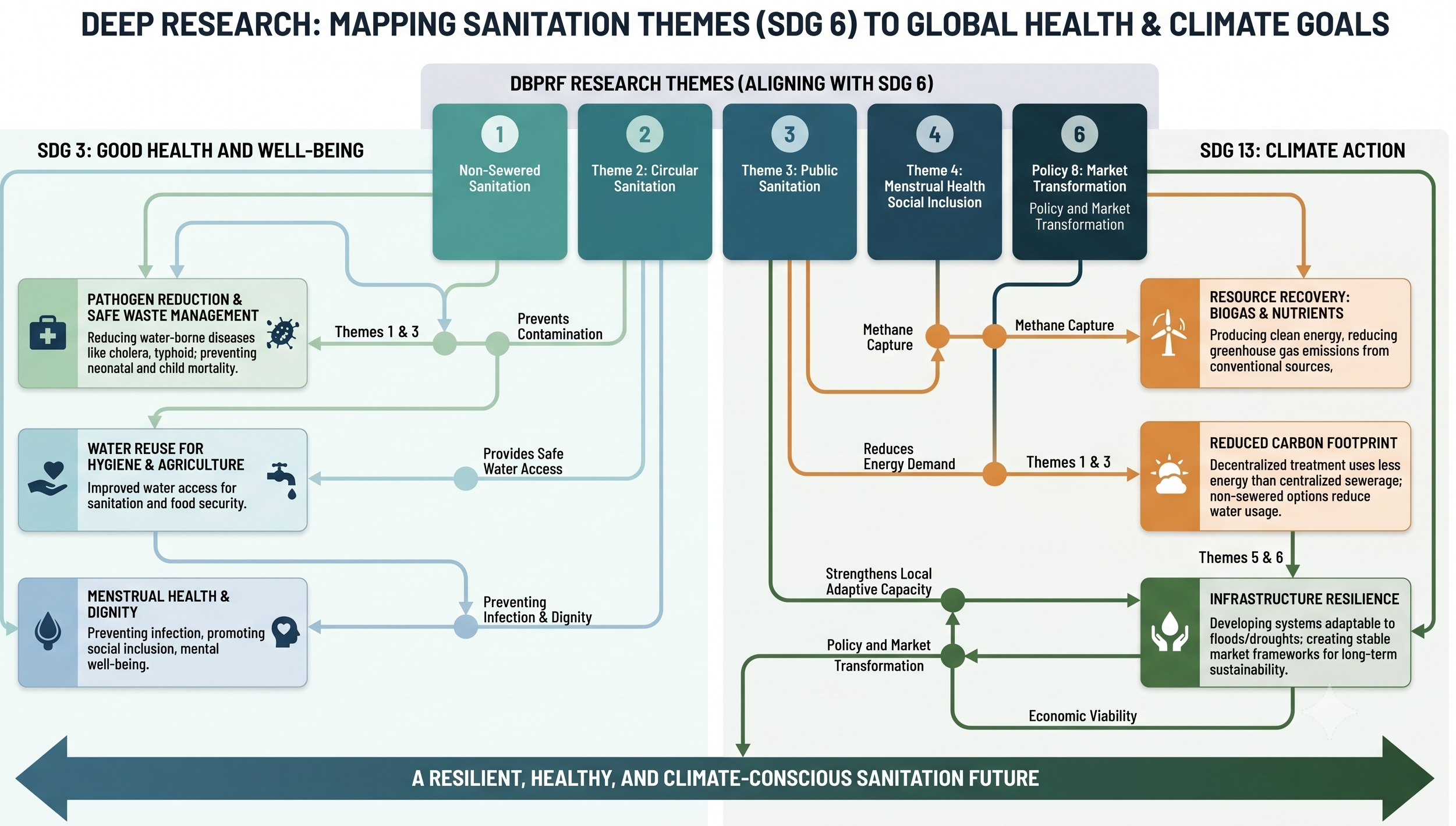
DBPRF's six research themes are designed to advance SDG 6 — safe water and sanitation for all — by addressing the implementation gaps that emerge after toilets are constructed. Together they support the transition from toilet access to safely managed sanitation, covering technology, circular resource use, citywide planning, gender inclusion, operational sustainability and policy adoption. But their impact extends beyond SDG 6. Through the interlinkages shown below, DBPRF's research contributes directly to SDG 3 (Good Health and Well-being) and SDG 13 (Climate Action).
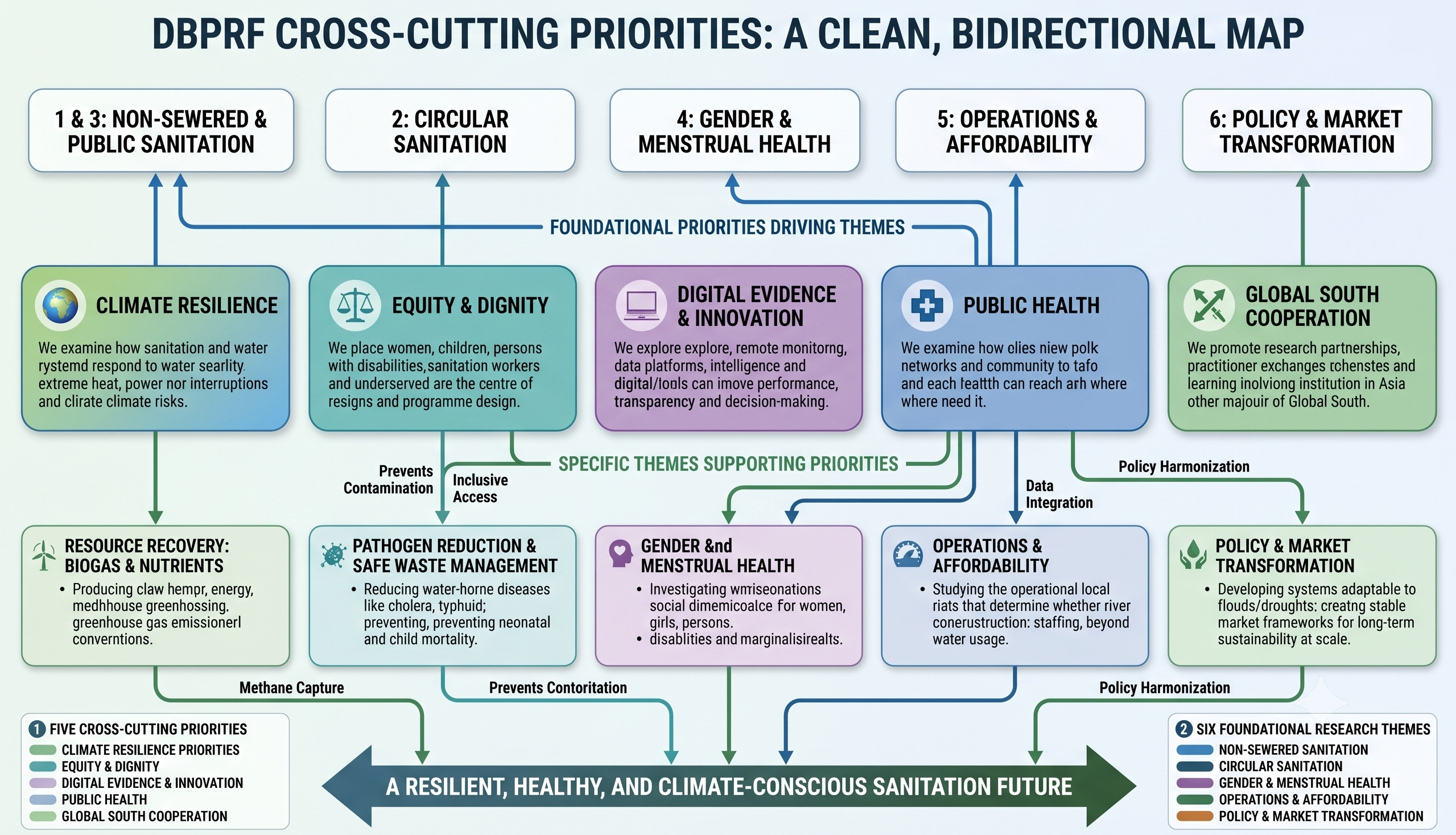
Our six research themes are united by five cross-cutting priorities — Climate Resilience, Equity and Dignity, Digital Evidence and Innovation, Public Health, and Global South Cooperation — that run through every area of DBPRF's work.
We do not work alone. Our research is designed to be collaborative — bringing together the rigour of academic institutions, the reach of development organisations, the resources of international funders and the authority of government agencies.
We work with universities and academic partners — including the University of Portsmouth — to ensure our research meets the highest standards of evidence and reaches global audiences through peer-reviewed publication and knowledge exchange.
We engage with foundations such as the Gates Foundation to align our work with international priorities in sanitation, public health and sustainable development, and to access resources that allow research to scale.
We partner with government agencies at national and state level — including ministries, urban local bodies and regulatory institutions — to ensure findings inform policy, shape standards and influence procurement.
We collaborate with NGOs, community organisations and civil society partners who work directly with the communities our research is meant to serve — ensuring our evidence is grounded in lived reality.
The Dr. Bindeshwar Pathak Research Foundation is an initiative of Sulabh International Social Service Organisation — one of India's most respected voluntary organisations, with a presence in more than 1,400 towns and cities and a record of social reform spanning five decades.
That relationship gives DBPRF something rare: direct access to one of the world's largest sanitation field networks. Our research is not conducted on hypothetical systems. It is conducted on toilets that are used by real people, every day, across India.
Sulabh has demonstrated that sanitation can be transformed at scale. DBPRF exists to understand how — and to generate the evidence that allows others to do the same.